Digging and retaining walls: locate request and permits
Before you dig or build a retaining wall: the free Info-Excavation locate request, permits in Laval and Terrebonne, and when an engineer is required.
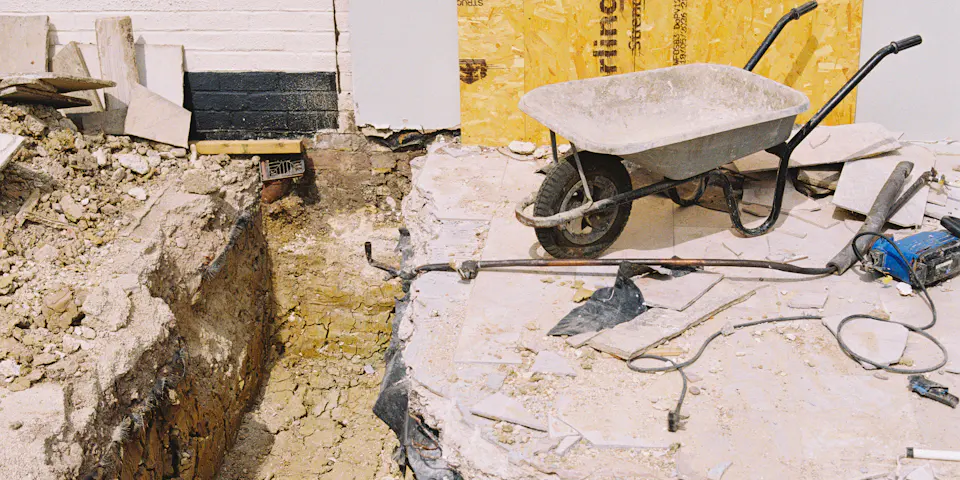
Redoing a foundation, laying a drain, digging for a pool or holding back a slope: all of these start with excavation. Two checks come before the first shovelful: what runs under the lot, and what the city requires for the structure. This guide draws on the Info-Excavation pages (in French), the Régie du bâtiment du Québec (RBQ) page on excavation work (in French), Hydro-Québec’s page on what to do before you dig and the rules of Laval, Terrebonne and Baie-D’Urfé, all read on November 3, 2026.
1. The locate request: free, and done before digging
Info-Excavation takes locate requests and notifies its member companies (telecommunications, electricity, gas and others), which send a plan or mark their lines on site with stakes, flags or paint. According to its FAQ, the request is free, made online, and also meant for homeowners who put up a fence, redo their landscaping, install a pool or spa, plant a tree or dig near the house. Info-Excavation also says:
- allow 3 business days, not counting the day of the request, for planned work; an emergency (water main break, gas leak, risk of collapse) is reported by phone at 514-286-9228 or 1-800-663-9228;
- the request is not mandatory, but whoever digs, even on their own land, can be held liable for damage; if the request was made properly and the instructions followed, they are not liable for a line a member failed to locate or mislocated;
- private lines (buried at your request or by a previous owner) are not located for free, and owners of networks that are not members must be contacted directly;
- with no work date yet, a free plan request is sent within 5 business days.
Info-Excavation reports that in 2025, 31% of damage events were due to the absence of a request. For contractors, the RBQ asks that the request be filed at least 4 business days before work starts; it stays valid until the end date written on it, for up to 180 days. A contractor who damages buried infrastructure pays for the repairs, the incident goes on its licence file and, if failures persist, the Building Act provides sanctions up to the withdrawal of the licence. Ask the company for its locate request number. Hydro-Québec adds: never dig within 1.5 m of a pole or guy wire, unless a temporary support system verified and approved by Hydro-Québec is in place.
2. Retaining walls: a certificate, sometimes an engineer
- Laval: according to the page Haie, clôture, muret et mur de soutènement (in French), a low wall needs no certificate unless a PIIA applies, but adding or altering a retaining wall requires a certificate of authorization ($84 for the first 500 m², plus $56 per additional 500 m²). For a high wall, 1.8 m or more, plans signed and sealed by an engineer and a copy of the engineer’s site supervision mandate are required.
- Terrebonne: form C-04 (in French, updated January 21, 2026) states that under zoning bylaw 1001 a retaining wall is at least 1 m high. The application includes a plan of the wall, a topographic survey by a land surveyor before and after the work, the fill materials and an engineer’s attestation confirming the wall’s stability and safety; in a landslide-prone zone, a geotechnical study is added.
- Baie-D’Urfé: the town requires a permit for any retaining wall 1 m high or more, with a structural plan signed and sealed by an engineer and cross-sections showing the soil (list of required documents, in French).
3. Foundations, drains and archaeological finds
In Laval, a new foundation needs a permit; replacing an existing French drain does not, but adding one does (page Rénovation résidentielle extérieure, in French). Laval’s excavation permit, for its part, covers digging in the public right-of-way or a City servitude: it is annual, costs $2,000 and is issued only to contractors holding subclass 1.4 or 2.5. The City also reminds owners that Québec’s Cultural Heritage Act requires anyone who discovers an archaeological remain to report it without delay to the Minister of Culture and Communications.
4. Which RBQ licence?
According to Schedules II and III of the Regulation respecting the professional qualification of contractors and owner-builders (B-1.1, r. 9), subclass 2.5, excavation and earthwork, covers digging, moving, compacting and levelling soil or granular materials. Subclass 2.6, piles and special foundations, covers among other things excavation shoring, tie-back anchors and underpinning. Subclass 2.7, site work, includes fences, paving and interlocking pavers. Check the licence before signing, and ask who gets the permit and the locate request.
In Montréal’s open permit data (in French), from October 27, 2025 to October 26, 2026, 158 permits mention excavation, 83 of them in Verdun, and 95 a retaining wall, 21 of them in Outremont. For companies near you, see renovation in Laval, in Terrebonne or in the West Island, or describe your excavation work. See also French drains and residential pools.
Concrete and foundations in the main cities
Montréal 296Laval 118Mirabel 44Terrebonne 36Longueuil 31Repentigny 26Blainville 26Brossard 22Mascouche 19Belœil 12