Pyrite under the slab: signs, SPPI index and BNQ standard
Pyrite under a concrete slab: the signs found by a CMHC-funded South Shore study, the BNQ 2560-500 swelling index (IPPG/SPPI), its limits and the licence.
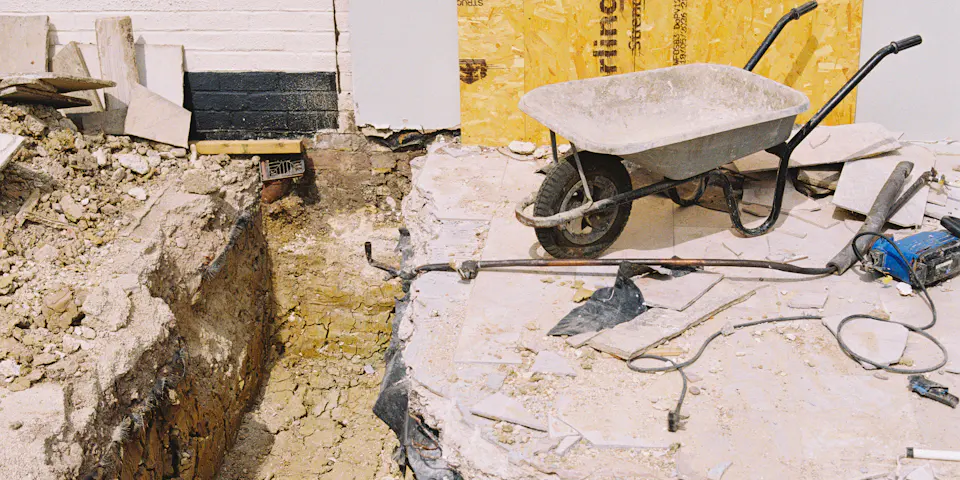
A garage slab that heaves, star-shaped cracks in the basement: a study carried out on Montréal’s South Shore linked these symptoms to swelling pyritic backfill under the concrete slab. This guide summarizes two sources: a study published by Canada Mortgage and Housing Corporation (CMHC) and the Bureau de normalisation du Québec (BNQ) page on standard BNQ 2560-500, both read on November 3, 2026. It does not replace an expert assessment of your house.
1. What the CMHC study observed
The report Analyse des dommages structuraux de bâtiments résidentiels associés aux problèmes de remblais pyriteux (in French with an English executive summary, December 2004) was carried out by university teams, including one from École Polytechnique de Montréal, under the Comité technique québécois, with funding from CMHC; its conclusions are the authors’. Nearly 800 single-family cases were considered, at least 200 of them examined on site, in Longueuil, Boucherville and Saint-Bruno-de-Montarville. According to the summary, swelling of granular foundations made of pyritic clay shales was the main cause of the slab heaving studied.
2. The signs found
The report separates two locations:
- Garage: slab heaving, star-shaped and longitudinal cracks in the slab, cracks in the foundation walls. In 70% of the 197 garages visited, the heaving measured 1 to 30 mm.
- Basement: slab heaving and star-shaped cracks. In the 224 basements visited, nearly 58% of cases showed no heaving; wall cracks were often absent or minor there, and could come from something other than the backfill.
Whitish powder at the cracks and at the slab-wall joints was rarely seen, possibly because owners had cleaned it up. The authors also note that several mechanisms may be involved in some complex cases: sulphate action, shrinkage or geotechnical problems, in addition to swelling.
3. The SPPI (IPPG) and standard BNQ 2560-500
Standard BNQ 2560-500 sets out the test method for the swelling potential petrographic index (SPPI, “IPPG” in French) of aggregates, and recommends chemical analyses when required. It is used to assess the sulphate swelling potential of aggregates sold as backfill under non-structural concrete slabs in new buildings, or for the renovation of those slabs, and applies to dense-graded material and clear stone from quarries, gravel pits or sandpits. The current edition replaces the one of November 28, 2003, and the standard itself is in French only.
The BNQ’s caution matters for owners: the method may be used in appraisals of existing buildings, but should not be used indiscriminately as a criterion for replacing materials. An SPPI result should therefore be read with the rest of the assessment.
4. What the report recommended
For houses where the swelling was attributed to pyritic backfill, the authors considered it reasonable to replace the backfill with a certified non-swelling aggregate following the CTQ-M100 procedure; they observed that the expansion showed no sign of slowing as long as sulphides remain available and temperature and humidity stay similar. For new construction, they pointed to DB aggregate (under-slab granular material) and strongly recommended a vapour barrier and sulphate-resistant cement, with a slab at least 10 cm thick and a compressive strength of at least 20 MPa. They stress that their statistics apply to the houses visited and that any extrapolation calls for great caution.
5. The work and the licence
In Montréal’s open permit data (in French), 13 permits issued from October 27, 2025 to October 26, 2026 mention pyrite; their descriptions refer to removing the pyrite and redoing the concrete slab of the basement or garage. According to Schedules II and III of the Regulation respecting the professional qualification of contractors and owner-builders (B-1.1, r. 9), subclass 2.5 covers excavation and earthwork, 3.1 structural concrete and 3.2 small concrete works, including placing and finishing. Ask the company which ones it holds, check its licence and ask for a quote that names the replacement aggregate and its certification. For a recent house, see also the new home warranty.
To find companies on the South Shore, see renovation in Longueuil, in Boucherville or in Saint-Bruno-de-Montarville, or describe the cracks in your slab so licensed companies can reply. See also foundation cracks.
Concrete and foundations in the main cities
Montréal 296Laval 118Mirabel 44Terrebonne 36Longueuil 31Repentigny 26Blainville 26Brossard 22Mascouche 19Belœil 12