Poor renovation work in Quebec: remedies against contractors
Poor or abandoned renovation work in Quebec: acceptance and holdback, legal warranties, formal notice, small claims and the RBQ licence bond.
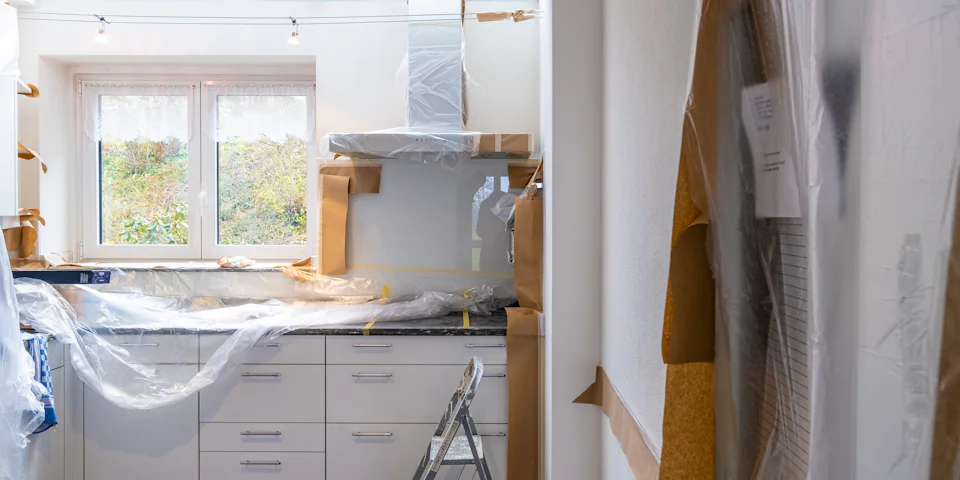
Work left unfinished, sloppy finishing, a leak after a roof job: when a contractor does not deliver what was agreed, the law gives you remedies. This guide summarizes the Civil Code of Québec (articles on contracts for work), the pages of the Office de la protection du consommateur (OPC) and those of the Régie du bâtiment du Québec (RBQ), checked on October 29, 2026. It is general information, not legal advice: for a specific case, see a lawyer or a notary.
1. What the contractor must deliver
According to the OPC, the work must match the description in your contract, what the contractor told you and the contractor's advertising. That is why a detailed written contract matters (see comparing quotes). During the work, article 2117 of the Civil Code lets you examine the progress, the quality of materials and work, and the statement of expenses, as long as you do not interfere with the job.
2. As soon as you see a problem
- Take dated photos and write down what you see, as it happens.
- Keep the contract, the quote, the invoices, proof of payment and the messages you exchanged.
- Notify the contractor in writing (email or letter) and ask for a correction. If the contractor's written warranty applies, the OPC notes that you must first ask the contractor to do what is needed.
- Check the RBQ licence of the business on the date of the contract: it matters for the licence security (section 7).
3. Acceptance of the work and holdback
Work is completed when it has been produced and is ready to be used for its intended purpose; acceptance is the act by which you declare that you accept it, with or without reservation (art. 2110). Write down your reservations at that moment, with the date.
- You are not bound to pay the price before the work is accepted (art. 2111).
- At the time of payment, you may withhold a sufficient amount to cover the reservations you made about apparent defects or poor workmanship, until they are corrected, unless the contractor gives you sufficient security (art. 2111).
- If you cannot agree on the amount to withhold, it is assessed by an expert chosen by both parties or, failing that, by the court (art. 2112).
- Accepting without reservation does not take away your remedies for nonapparent defects or poor workmanship (art. 2113).
4. Warranties provided by law
- One year for poor workmanship: the contractor (and, as the case may be, the subcontractor, architect, engineer or technologist who directed or supervised the work) warrants the work for one year against poor workmanship existing at acceptance or discovered within one year after acceptance (art. 2120).
- Five years for loss of the work: they are liable for the loss of the work occurring within five years after the work was completed, if it results from faulty design, construction or production, or from defects in the ground (art. 2118), unless they prove one of the grounds for release in article 2119 (for example a decision imposed by the client).
- Materials: according to the OPC, goods supplied are also covered by the legal warranties of use, reasonable durability and against latent defects; you may deal with the merchant, the manufacturer or both.
- Time limit to act: as a general rule, an action is prescribed by three years (art. 2925); when the injury appears progressively or late, the period runs from the day it first appears (art. 2926). Do not wait: a lawyer can tell you which period applies to your case.
New house or new condo? A separate warranty applies (the mandatory guarantee plan for new residential buildings); according to the RBQ, the licence security does not cover that damage.
5. The steps the OPC recommends
- Negotiate: first try to reach an agreement with the contractor.
- Formal notice (mise en demeure): if negotiation fails, send a formal notice (OPC page in French). It must be in writing and give sufficient time to perform, having regard to the nature of the work and the circumstances (art. 1595). The OPC advises keeping a copy and proof of delivery: registered mail with signature on receipt, or delivery by a bailiff.
- Court: if that fails, you can go to the Court of Québec. The Small Claims Division hears claims of $15,000 or less (not counting interest), and its judgment cannot be appealed; above that, it is the Civil Division.
- Complaint: you can also contact the OPC to find out whether you can file a complaint.
6. Abandoned work: resiliating the contract
The client may resiliate the contract unilaterally, even if the work is in progress (art. 2125). The client then pays, in proportion to the agreed price, the actual costs and expenses, the value of the work done before the notice of resiliation and, where applicable, the value of property supplied that the client can use; the contractor repays any advances received in excess of what was earned (art. 2129). The contractor, for its part, may resiliate unilaterally only for a serious reason and never at an inopportune moment; otherwise it must compensate the client for the injury caused (art. 2126). Resiliate in writing and keep proof; a lawyer can help you work out what each side owes.
7. The RBQ licence security (bond)
Every contractor licensed by the RBQ (or the CMEQ, CMMTQ) provides a licence security that can compensate a client for work not performed, unfinished or poorly done. According to the RBQ claim page (in French; checked on October 29, 2026; draft regulations published for comment in February 2026 would raise the amounts and extend the period to discover poor workmanship from one year to five; the page still showed the current rules on November 1, 2026, so check again before relying on them):
- it is $40,000 for a general contractor and $20,000 for a specialty contractor;
- the contractor must have held a valid licence when the contract was signed or during the work; you need written proof of the contract, and you must have paid an amount and tried without success to settle the problem with the contractor;
- the defects must have been noticed within 12 months after the end of the work, and a first legal step (or a claim without judgment) taken within 3 years of noticing the problem;
- with a final judgment, your chances are much better; without one (for example, the business closed or cannot be found), the surety must agree to make you an offer;
- once a first compliant claim is admitted, other clients have 6 months to claim; if the total exceeds the security, it is shared pro rata;
- excluded among others: damage caused by delays, moral and punitive damages, lawyer fees, and new houses or condos.
An unlicensed contractor has no licence security: one more reason to check the RBQ licence before signing. In case of fraud or threats, the RBQ advises contacting the police; if the contract was signed at your home, see also door-to-door sales and scams.
Small claims in Greater Montréal: where to file, mediation and free help
If the case goes to the Small Claims Division, you do not have to travel far: for a claim about a consumer contract, the court of the consumer’s domicile has jurisdiction, whether you are the plaintiff or the defendant (page Where to file a claim, updated April 13, 2026). A homeowner in Laval, Longueuil or on the island can therefore generally file close to home. For a contested claim of $5,000 or less, mediation is compulsory; it has applied in every judicial district since March 2026, and the Ministère de la Justice pays the mediator’s fees for up to 3 hours (page Compulsory mediation, updated April 22, 2026).
Before you file, have your case reviewed for free: the Info Justice centres offer a small claims pathway (“Parcours Petites créances”) and consultations with lawyers, by appointment, in Montréal for residents of the city, and at the Laval-Laurentides-Lanaudière centre for Laval and the North Shore (pages in French, read on November 1, 2026). To have the work finished or redone, you can look among renovation contractors in Mercier–Hochelaga-Maisonneuve, companies in Laval or those in Châteauguay.
8. Having another contractor fix it
- Before having the work redone, document its condition (photos and, if needed, an expert report): this is your evidence.
- Quotes and invoices for the correction also justify the amount claimed, according to the RBQ.
- Choose a contractor whose licence covers this work (see general or specialty contractor).
9. Checklist
- Dated photos, contract, invoices and proof of payment kept.
- Written reservations at acceptance; a sufficient amount withheld for apparent defects.
- Poor workmanship: one-year warranty after acceptance; loss of the work: five years after completion.
- Negotiation, then a written formal notice with a deadline and proof of delivery, then court (small claims up to $15,000).
- RBQ licence security: defect noticed within 12 months, legal step within 3 years.
When it is time to have the work redone, you can describe what needs fixing and compare the quotes you get: they also serve as evidence of the amount claimed.
Renovation, construction and general work in the main cities
Montréal 3,211Laval 1,220Longueuil 442Terrebonne 442Mirabel 325Repentigny 236Brossard 210Blainville 209Mascouche 182Boisbriand 132