Smoke detectors: where to install, test and replace them
Smoke detectors: how many you need and where, the monthly test, batteries, replacing them every 10 years and the Montréal fire by-law for rental homes.
In a fire you have less than 3 minutes to get out of the house, the Government of Quebec (in French) reminds homeowners. With the clock change and the heating back on, it is a good time to check your smoke alarms, and to know what falls to the owner and what falls to the tenant.
1. Where to install them
- One alarm on every floor, including the basement, in the hallway near the bedrooms, in each bedroom where someone sleeps and near the stairs.
- Two alarms, one at each end, on a floor longer than 10 metres.
- On the ceiling, at least 10 cm from the wall; on the wall, 10 to 30 cm below the ceiling; at least 1 metre from fans, air conditioners, air outlets and return vents.
- Ionization in bedrooms and hallways, photoelectric near the kitchen and bathroom, and a strobe-light model if someone is hard of hearing.
2. Testing and upkeep
- Every month, press the test button for a few seconds.
- Change the battery when the alarm gives an intermittent signal and when you move into a new home. The government recommends long-life lithium batteries.
- Never paint a smoke alarm.
- Replace each alarm 10 years after the manufacturing date printed on its case. It must carry the ULC mark.
A unit that no longer responds to the test button after a battery change, or whose manufacturing date can’t be read, should be replaced right away.
3. Hard-wired alarms
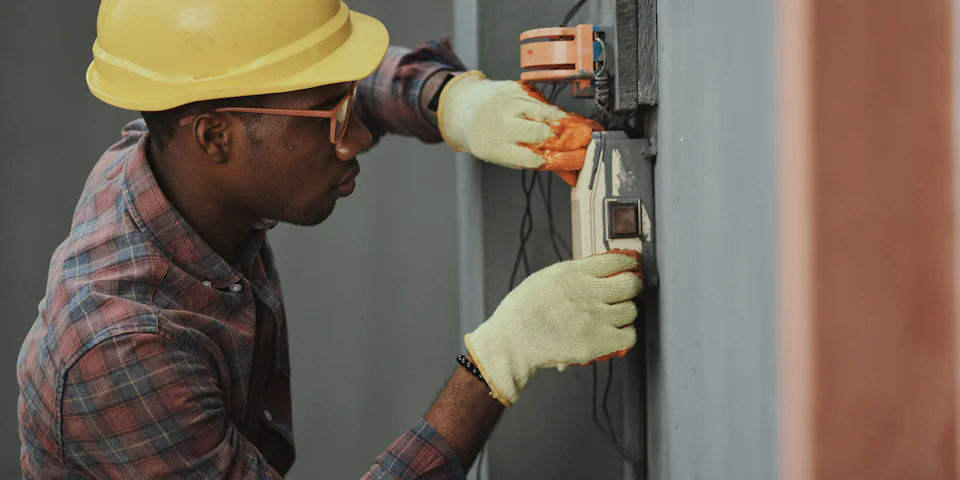
A hard-wired alarm runs on 120-volt household current and must also have a backup battery for outages. Interconnected alarms all sound together: when one picks up smoke in the basement, the one on the bedroom floor wakes the household. A hard-wired alarm cannot be replaced with a battery-only model. To add or replace wired units, you need an electrician whose licence includes subclass 16: the licence search confirms it in seconds.
4. In the Montréal agglomeration: By-law RCG 12-003
The Service de sécurité incendie de Montréal (SIM) summarizes the obligations of the By-law concerning the Service de sécurité incendie de Montréal (RCG 12-003), which applies across the whole agglomeration, from Montréal-Est to Senneville:
- The owner provides the alarms and installs them where the by-law requires; owners and tenants share responsibility for making sure they work.
- How many: at least one alarm per floor in every dwelling, basement included; in buildings constructed after June 2015, one is also required in each sleeping room.
- Buildings constructed before 1985 must have smoke alarms powered by a non-removable lithium battery with a 10-year lifespan.
- Existing 120-volt alarms don’t have to be swapped for lithium models: according to the SIM, they go beyond the by-law’s fire safety objectives.
So in a 1950s triplex in Rosemont or Verdun without hard-wired alarms, the owner needs sealed lithium units on every floor. Elsewhere in Greater Montréal, in Laval, Longueuil or the suburbs, your town’s fire department can tell you which type is required in your home.
5. Smoke, but also carbon monoxide
A smoke alarm does not detect carbon monoxide. If the house has a fuel-burning appliance or an attached garage, read our guide on power outages and carbon monoxide, and for older installations, aluminum wiring and old panels.
To add hard-wired, interconnected alarms, electricians serve Le Sud-Ouest, Boisbriand and Vaudreuil-Dorion; just give the number of floors and alarms in the form.
Electricians in the main cities
Montréal 627Laval 341Longueuil 84Terrebonne 81Mirabel 67Repentigny 48Blainville 41Mascouche 39Brossard 33Saint-Eustache 31